

Elbrus 
Europe: 5,642m / 18,510ft
43° 21' 18" N,
42° 26' 21" E
First ascent: F Crauford Grove, F Gardiner, H Walker, A Sottajev and P Knubel, 1874

Climate at Elbrus
Typical weather stats during the challenge
- 20 °C
Average temperature - 3m
Depth of snow
in late winter

Elbrus is Europe’s 7 Summit and the highest point in the Russian Caucasus.

About Elbrus
This range of mountains stretches for 550 miles linking the Caspian Sea to the Black Sea, and creates a natural boundary between the steppes of Russia and the southern states of Azerbaydzan, Georgia and Armenia. Mt. Elbrus is an extinct double-headed volcano with it’s west summit standing at 5,642m/18,510 ft and the east summit slightly lower at 5,621m/18,442 ft. The conical shaped Elbrus stands in the highest and most extensively glaciated part of the Caucasus mountain range.
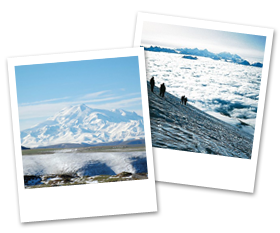

- Elbrus is an extinct volcano which last erupted around 50 AD. It’s crater is approximately 400 meters wide and is now filled with ice and snow.
- The Caucasus Mountains are the result of a tectonic plate collision between the Arabian plate moving northward and the Eurasian plate. They form a continuation of the Himalayas, which are being pressed upwards by a similar collision zone with the Eurasian and Indian plates. The entire region is regularly subjected to strong earthquakes from this activity.
- The Germans briefly occupied the mountain during World War II with 10,000 mountaineer soldiers.
- Elbrus’ local Balkar name of 'Mingi-Tau' means 'Resembling a thousand mountains' because it’s so big.
- Elbrus is 832m/2,730ft higher than Mont Blanc.